|
|
REVIEWS
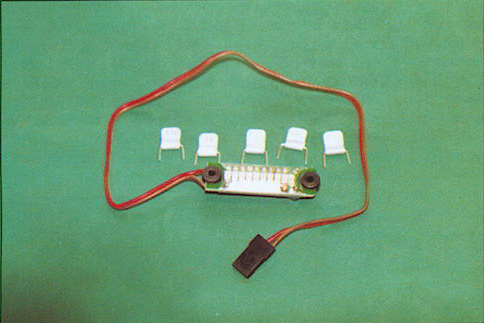
On-Board Battery Checker
Price: $16.00
reviewed in Jet International,
February/March 2001, p.53. Reprinted with permission.
|

|
|
A range of on-board battery voltage monitors
has been introduced. The monitors are supplied with a
selection of plug-in resistors marked 4.8v, 6.0v, 7.2v,
8.4v, and 9.6v to enable the monitor to be used with NiCad
batteries with 4 to 8 cells. In operation the unit is
installed in a visible place on the model with double-sided
adhesive tape or two screws through the rubber grommets.
The display has three red, four yellow and three green
LEDs.
|
|
If any green LED is lit the battery voltage is regarded
as safe. If a yellow LED is lit the battery is low enough
to serve as a warning that not much battery capacity remains.
If a red LED is lit the battery voltage is dangerously low.
|
Automix
reviewed by Dave Bowen, published in Radio Control Jet
International, April/May 1999, pp.10-11. Reprinted with permission.
|

|
|
I was asked by the Editor
if I would like to experiment with a device that would
look after the fuel mixture settings of the fan engine
so I could concentrate on my flying. Was he trying to
tell me something?
A parcel arrived in a few days and on opening the package
my first thought was "how do I get all that stuff in the
model?" There were a lot of bits to this device which
were all safely packed for transit but a closer look showed
that not all the components are installed in the model.
Starting at the top we have:
The Automix unit.
An LCD indicator panel.
Exhaust Gas Temp Sensor with rubber washer and grommet.
Loctite 71 thread lock
Instructions.
Fuel proof Automix decal.
|
|
I know the old phrase 'if in
doubt read the instructions' but in this case do it. They
are very good, clearly written and explain in great detail
exactly what to do.
So how does the Automix work?
Basically, it monitors the exhaust gas temperature and automatically
adjusts the mixture needle via the inflight adjustment to
keep the engine running at its most efficient temperature.
Putting it simply so even I can understand, once the optimum
temperature has been set on the Automix, should the engine
lean out then the temperature of the exhaust will rise.
The Automix senses this via the temperature sensor that
is installed into the header and opens the mixture valve
to richen the needle valve setting, thus lowering the exhaust
temperature.
Initial Installation
The Automix is connected between the receiver and the mixture
control valve servo. So the first job is to connect the
sensor lead to the Automix (this is connected to the header
later). Now connect the LCD display unit to the Automix.
The linkage from the servo to the mixture valve is important
and must be set 11 mm from the center of the servo arm.
The other end must be connected to the outer hole on the
mixture valve arm, which is clearly shown diagrammatically
in the instructions. Next on the agenda is to set up and
do some testing. To do this you need to set up your radio
gear. The mixture knob must be set at 50% i.e. in the middle.
High and low ATV must be set to maximum. The L.E.D. on the
Automix will be on and the surrounding temperature will
show on the LCD display panel. Check that when you operate
the mixture contol open is open and closed is closed. Next
you need to set the system by pressing the button on the
Automix for 1 second. Now hold the temperature sensor between
thumb and forefinger (that's why we have not installed this
component yet) and you will see the mixture valve open and
an increase in temperature will show on the display panel.
Temperature Sensor Installation
A hole has to be drilled and tapped in the header 3/4" inch
from the engine beginning f the header. Once this task is
completed, the sensor is carefully screwed in (Loctite is
supplied just for this purpose) having passed the lead through
the cover cap. The remainder of the lead is routed through
to the Automix securing it along the way. This sequence
is again shown clearly in the instructions. Right we are
now ready, let's go flying!
Final setup and Flying
Wait for it. Before you send your jet off into the skies
there are still a few things to do. You must set the Automix
up first otherwise it won't work correctly. First start
your engine. Now run the engine up to full throttle. Once
there, adjust your mixture using your transmitter knob until
optimum performance is reached. Push the red button on the
Automix and the red LED which should be on, will now flash.
This is what the instructions say and they have the final
word. Now glance at the LCD display and you will see the
exhaust gas temperature being displayed. Throttle back to
idle and disconnect the LCD display. You are now ready for
flying. The Automix has not yet taken over your mixture
control as yet so you will still have control over the mixture
during that vital takeoff period when the Automix will sense
the temperature that it was set at. This is the threshold
temperature. When the Automix senses the threshold temperature
for the second time, it wil activate and take over the mixture
control for you. Even though the Automix is looking after
your engine you still have control. By turning the mixture
control on your transmitter you are able to raise or lower
the set temperature. The Automix needs to be set up before
every flight which is no problem. Next time move selector
switch to set, adjust the peak temp., press the set button
and move the selector to run. That's it. You're ready to
fly! An extra addition is that the LCD display becomes a
battery checker at the flick of a switch--brilliant!
Did it or didn't it?
Well you might be wondering if the Automix actually worked
and how do you check that it does. I ran the engine up and
set it all up. I then adjusted the throttle to simulate
the second threshold temperature. I tipped the aircraft
onto its nose (my fuel tank is up front) to lean out the
engine and the remote needle moved richening the mixture.
Conclusive proof that it does work. Incidentally my wings
come off the model so I can see the remote needle and its
servo, just in case you were going to ask. I flew the aircraft
for three or four flights during the test session and found
no problems at all. Control response was smooth there's
no doubt that this device will protect your engine therefore
giving longer life. The safety aspect of fitting a unit
such as the Automix is an important one, of course, and
anything that improves safety can't be bad, can it? Full
marks to Mini Hobby for producing this simple and easy to
use unit.
|
AutoSpeed
Three Reviews:
(1) reviewed in Radio Control Jet
International, April/May 2000, p.65. Reprinted with permission.
|
Mini Hobby Autospeed
Mini Hobby ATL, inl. has developed
an automatic speed control device called Autospeed that
enhances flight safety by controlling maximum and minimum
aircraft speed.
|
|
Autospeed uses a microprocessor
and a precise pressure sensor to control the speed of an
aircraft to a set value by controlling the engine power.
Pre-set values for maximum (VNE) and minimum (VS) can be
selected. In flight, the automatic mode can be activated
by an auxiliary channel to hold the current speed. The automatic
mode is disengaged by the auxiliary channel or by smartly
moving the throttle stick. You have a working pitot tube
on your model as in the photograph, so form a queue behind
me!
Low Speed Protection: If the
Auto mode is selected when the speed is below the Minimum
pre-set, the unit will hold the minimum set speed rather
than the current speed. Example: if flying at 35 mph and
the Minimum speed is set at 45 mph, the unit will keep the
speed at 45 mph. This feature will help to prevent a stall
condition. Overspeed protection: whenever the speed exceeds
the maximum set, power is automatically reduced.
|
(2) reviewed by Don Lowe, published
in RCM, June 2000, pp.44,46. Reprinted with permission.
|

|
|
Technology
I love it! This R/C hobby
has something for everyone; from the most simple trainer
model with no frills and very reliable inexpensive radios
to multi-engine turbine-powered models worth $20K!
Big models are very popular
and the availability of ready-built beautiful airplanes
and super engines assures lots of fun, for lots of bucks!
|
|
I recently witnessed a demo
of a speed control device for models which allows one to
dial in a safe (never exceed) velocity and a minimum (please
don't stall) speed. It is the development of Mini Hobby
ATL Inc., and Roy Dutton of the R/C World Flyers. Essentially,
it senses airspeed and couples this information through
the essential electronics to control the throttle. Now,
all we need to know is what are these safe limits for each
aircraft design.
You may know that currently
AMA limits the thrust-to-weight of turbine models to control
the max safe speed of these aircraft. It really would be
best to have a device which does this automatically. How
many models have you seen destroyed by control flutter?
I have seen more than my share and have also survived several
instances of it (except one).
Control flutter is an insidious
killer, very little understood, and is speed dependent.
If you ever encounter flutter, slow down quickly
or you may lose the surfaces (and control). As an aside,
flutter can be controlled by 91) keeping the velocity below
flutter speed, (2) very stiff control set-ups, and (3) counter-balancing
the control surfaces, a la full-scale practice.
A friend of mine recently lost
a beautiful P-38 due to elevator flutter when he flew the
aircraft at a little faster airspeed than normal. The full-scale
P-38 had control surface counterbalances. Often, you can
survive aileron or rudder flutter by rapidly slowing down,
but elevator flutter is a killer, since the aircraft pitches
down!
How many beautiful scale models
have you seen damaged by stalling on the landing approach?
Wouldn't it be neat to have a device that helps thwart that
possibility? For further information on the availability
of this gadget, contact: Mini Hobby ATL, Inc., 10266 NW
47th St., Sunrise, FL 33351, phone (954) 746-3095, fax (954)
746-3095, e-mail:
minihobby@compuserve.com
Incidentally, my very inventive
friend, Roy Dutton, is working on a completely automated
flight control system which will include automatic landing!
Stay tuned.
|
(3) reviewed in Model Airplane News,
July 2000, p.33. Reprinted with permission.
|
Unique Things
Watching the airborne activities
disclosed some interesting new things. How about Antonio
Tahan's compact, lightweight, airborne device that limits
speed to a preset point? Why, you ask? Well, a lot of these
turbines can drive the airframes well beyond reasonable
(and intelligent) speed limits; that is, the airframe will
self-destruct before the engine does. A device such as this
helps to ensure the safe operation of these models. Chris
Huhn had one installed in his JetCat; it was set to a mere
180mph!
|
Voltage Regulator
reviewed by George Steiner, published
in RCM, March 1999, p.121. Reprinted with permission.
|

|
|
In the past few years, an
idea has caught on for the need to produce better voltage
regulation for the on-board electrical operation of the
servos and other equipment. Some investigations have shown
that a wide variety of voltage bounce was being created
under heavy loads with the use of a total raw voltage
source like right off a 4-cell NiCd.
This prompted a solution to
increase the input source voltage supply and electronically
regulate a constant voltage to the receiver and servos
under any kind of load. This appears to have solved the
problem as it was designed to do. Now being offered is
a Voltage Regulator by Mini Hobby ATL Inc., that goes
between the ON/OFF switch and the receiver. The MH Regulator
is a powerful unit, but keep in mind, if the device is
not properly placed in operation per the manufacturer's
specification, nothing is gained. For example, you can't
use a low-capacity, higher voltage battery and expect
the regulator to compensate for this error. In general,
regulators for models require high capacity and higher
source operating voltages with adequate wiring when being
used to realize the potential they were designed for.
This is true of the MH device that has a rating of over
7 amps peak load capability.
The Mini Hobby Regulator was
run through a test and it followed close to the manufacturer's
specification.... It showed no bad habits and it does
consume some negligible power. (You do not get something
for nothing.) The size, as one can observe..., is very
small, with a weight of just .4 oz. with the connectors.
It is easy to install between the receiver power input
(marked as BAT in most cases) and the switch harness connection
that was designated for the receiver power input.
|
ECU Turbine Controller
reviewed by Tom Wilkinson, published
in Radio Control Jet International, December/January 1999,
pp.28-29. Reprinted with permission.
|

|
|
MH Turbine Controllers have
been designed and supplied for use with KJ-66, Turbomin
and JPX kerosene burning engines and are therefore probably
of great interest also to the "home builders" of gas turbines.
The system is designed to control the electric motor which
drives the fuel pump. Engine case pressure, referred to
in the operating instructions as compressor discharge
pressure (CDP), and exhaust gas temperature are monitored
to provide automatic limiting of the fuel pump if the
CDP rises above an adjustable pre-set limit, and shut
down of the pump if the CDP falls below an adjustable
pre-set limit or the temperature exceeds a pre-set (factory
adjustable) value of 790°C.
|
|
The system supplied for review
was the basic version V1.0 which does not have the over
pressure shut-down facility. A unit supplied for use with
the KJ-66 with over pressure limiting is designated version
V1.1 and there is a version V2.0 which has the addition
of a start button switch, which must be pressed to allow
the pump to start. All versions can be upgraded to V2.0.
The systems cost $275 for V1.0, $292 for V1.1 and $312 for
V1.2.
A comprehensive set-up procedure
is supplied with all versions of the controller which is
easy to understand and implement. There are no fuel pump
motor voltage adjustments to be made from the controllers
as they rely upon being operated in conjunction with a "computer"
radio system with the facility to adjust the throttle signal
High and Low ATV. The Instruction Manuals gives comprehensive
details of setting-up procedures.
The engine protection systems
(under-pressure and over-temperature) both initiate a complete
engine shut-down by stopping the fuel pump motor and preventing
it from restarting until the radio receiver is switched
off for three seconds. The over pressure limiting system
prevents the throttle from causing the engine to run above
the preset limit with the pilot retaining full control of
the engine up to that limit.
During engine starting the pressure
sensor will prevent the fuel pump from running until the
engine case pressure exceeds a pre-set value. The pressure
to be obtained before the fuel pump could run in the case
of the review system was higher than that which can be obtained
by the typical blower used to start some home-built engines,
having been factory-set to 0.315 bar, however it can be
adjusted to lower values for blower starting. The MH Turbine
Controller instructions only address starting with compressed
air, which should give turbine compressors speeds high enough
to generate case pressures of 0.135 bar.
The thermocouple
exhaust gas temperature (EGT) sensor causes an engine
shut-down at a temperature of approximately 790°C. The over-temperature
shut-down system will not cause an engine shut-down if the
thermocouple is disconnected or the connecting wires are
broken; the pump will keep running and would therefore continue
to do so even if the exhaust gas temperature went beyond
safe limits. At first sight this appears to be a short-coming
but the manufacturer explained that this is a deliberate
policy designed to give the maximum protection to the model
aircraft. The argument is that if the EGT sensor malfunctions
during engine starting the display will read zero and the
operator will be aware of this and will initiate a shut-down
manually, knowing that the over-temperature protection will
fail. Once an engine has been started and is running at
a satisfactory temperature it is unlikely to develop a fault,
which would give rise to an over-temperature situation,
which would not also be detected by the over- or under-pressure
sensor. So, if the temperature probe fails on a healthy
engine in the air it is undesirable to shut the engine down
unless a real problem exists and that would be dealt with
by the pressure sensor. An unnecessary engine shut-down
immediately after take-off is definitely to be avoided!
The temperature monitoring circuit
has adequate radio frequency suppression and does not suffer
from spurious readings unless the radio control transmitter
antenna is held (in the case of the reviewer's 35MHz Tx)
closer than six inches from the thermocouple probe. If MH
had not taken care of this it would be quite possible to
initiate a shut down while ground running by just getting
the Tx too close to the probe.
Versions V1.1 and V2.0 for the
KJ-66 are factory set to limit the gas turbine's compressor
discharge pressure (CDP) to 1.1 bar, (which is in line with
current recommendations from Jesus Artes in respect of operating
limits for the KJ-66 turbine wheel. However the over-pressure
limit of the controller can be adjusted from 0.8 bar 1.5
bar.
|
JPX 260K Turbine Controller
reviewed by David Gladwin, published
in Radio Control Jet International, April/May 1999, pp.14-16.
Reprinted with permission.
|

|
|
In our recent review of the
superb JPX 260K kerosene engine we described the fairly
simple electronics which, in conjunction with a mechanical
limiter on the fuel pump, control the engine's acceleration
and maximum output. There can be great virtue in the simple
and straightforward design philosophy of the Westbury
electronics which work very well. However, AMA rules for
the approval of this engine for use in the US
|
|
require that the engine should
have built-in protection to prevent damage and possible
failure in the event of overspeed or overtemp. To meet the
AMA requirements, Mini Hobby of Miami Florida, run by Antonio
Tahan, a former DC10 pilot, has designed and is manufacturing
a comprehensive turbine controller for the JPX 260K. Mini-Hobby
is already producing a range of excellent electronic devices
including the mixture controller for fan engines and the
BVM Jet Guard which protects the 260P from loss of oil pressure
and overtemp., within the fuselage as well as providing
a range of acceleration curves.
The Mini Hobby JPX turbine controller
consists of three main units, the controller itself which
is linked to a thermocouple which is installed on the engine
and a starter box with glow
driver. The controller incorporates a sensor which monitors
engine EGT and initiates an auto shutdown in the event of
significant overtemp. The unit also provides the engine
with acceleration control and will limit the maximum engine
speed by monitoring the compressor output; there is, therefore,
no requirement for an RPM sensor and none is fitted. This
CDP (compressor discharge pressure) monitor will also initiate
shutdown if engine CDP falls below a safe level which can
be set by the operator. The JPX factory recommends a MINIMUM
idle value of .2 bar for the 260K, rather higher than the
minimum idle of the propane engine which is .15 bar. Serious
engine damage can occur if engine speed falls to too low
a value as insufficient cooling air will allow serious overheating
inside the engine. This is probably the most serious risk
to any jet engine - full size or model. Maximum CDP can
be adjusted as required to allow a maximum value of 1.4
with a recommended reduction of .035 bar per 1000 feet above
sea level pressure (1013 MB or 29.92 inches of mercury).
The start unit, which remains
on the ground, is connected to the engine controller electronically
and with air and propane lines and incorporates a fuel pump
start switch to start the fuel pump at the appropriate point
in the engine start sequence. This unit takes engine temperature
from the controller and thermocouple ND is displayed on
a large LCD. Incorporated in the start unit are solenoid
valves to control air and propane feed to the engine and
a glow driver with a back-up power source powered by a rechargeable
battery. On the current unit, engine start is controlled
semi-automatically by the operator making the switching
to control the start sequence. Future developments may well
include a fully automatic start sequence.
The Mini-Hobby JPX Turbine controller
is available now and has been approved for the JPX engine.
Such engine electronics are not required for European use
and as soon as we have received a test sample from Mini-Hobby
it will be fitted to my own 260K in the Rafale for a full
review.
|
|